From Learning to Taking Action
A practical approach to helping students turn personal development ideas into everyday habits.
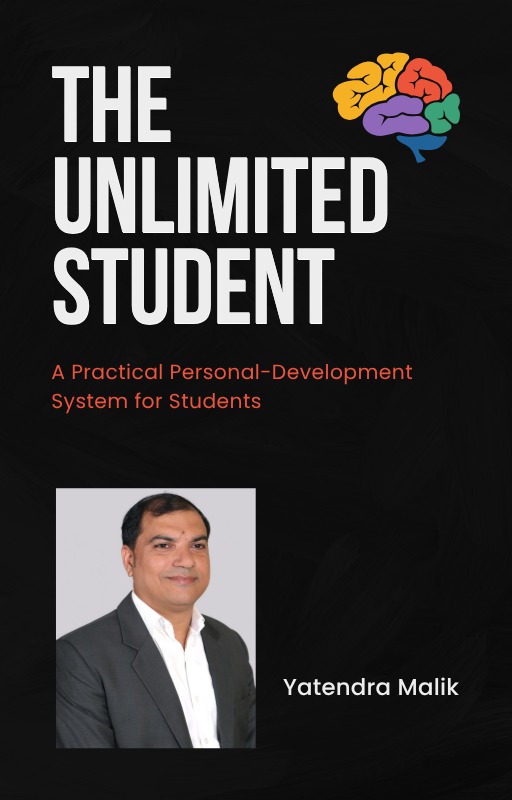
The Unlimited Student began as a book addressing challenges commonly experienced during student life.
It explores areas including procrastination, self-doubt, fear of failure, discipline, career decisions and communication, alongside other challenges such as overthinking, stress, focus and distraction.
Reading about personal development is only the beginning. The real value comes from applying a practical technique, practising consistently and observing what changes.
That philosophy has now evolved into a structured programme designed to help students move from understanding ideas to putting them into practice.
Understand the approach and learn practical techniques.
Apply selected techniques and build consistent habits.
Reflect on progress, challenges and practical application.
Review changes across selected development indicators.
Six important areas of student development, supported by a practical process that encourages learning, consistent practice and reflection.
Six Areas. One Integrated Programme.
The programme focuses on six important areas of student development that can be addressed through an integrated practical approach.
Move from knowing what needs to be done to actually taking action.
Develop greater confidence in personal abilities and potential.
Take meaningful action without letting fear hold you back.
Develop consistency, even when motivation is low.
Approach important career choices with greater clarity and confidence.
Become more comfortable expressing thoughts, ideas and opinions.
Learn. Practise. Repeat. Observe.

Students participate in an engaging session introducing the programme's concepts, perspectives and practical techniques.
Students continue practising the techniques independently in their everyday lives.
Consistency rather than perfection.Teachers or designated institutional coordinators can provide brief check-ins to support continuity during the practice period.
Students complete a simple assessment before and after the programme across the six focus areas.
This provides an initial picture of students' self-reported experience and helps guide continuous programme improvement.
Learn a technique, practise it in daily life, reflect on the experience and identify opportunities to improve.
Real development begins when knowledge becomes action. Our approach helps students move beyond understanding what they should do and begin practising it in everyday life.
Recognise the challenge and discover new perspectives.
Apply a practical technique in everyday situations.
Build consistency through small, repeatable actions.
Reflect on the experience and identify the next step.
Students often know they should study consistently, stop delaying important work, prepare for their careers and take better care of themselves.
Yet knowing what to do and actually doing it can be very different. The book describes this gap between knowing and doing as one of the central challenges of student life.
The goal is not just to know better, but to practise better—one action at a time.
Each principle supports students in turning awareness into thoughtful, consistent action.
Recognise the patterns influencing your thoughts and behaviour.
Look at challenges from a more constructive perspective.
Learn simple techniques that can be applied in everyday life.
Repeat useful actions rather than depending entirely on motivation.
Observe what changes and identify the next step.
Personal growth does not have to begin with a complete transformation. It can begin with one small step — repeated with intention and consistency.
You don't need to become a completely different person overnight. You just need to take the next step in the right direction.
Choose a perspective that helps you move forward.
Make a conscious choice that supports your growth.
Build a small routine that makes a difference.
Give your time and attention to what matters.
Take the step you've been putting off.
Show up today, then return and do it again.
The goal is not a temporary transformation. It is to help students develop practical patterns of thinking, deciding and acting that continue long after the programme ends.